
<img alt="" src="https://secure.inventiveinspired7.com/792353.png" style="display:none;">
FPCO 9-3

Extend Your Training Portfolio with Proven Cybersecurity Skills Training


A clear, student-relevant addition for educators looking to attract enrolments with practical, employer-recognised cyber skills training

Introduction


Educators are under increasing pressure to offer programmes that lead clearly to employment outcomes. In cybersecurity, that pressure is amplified: demand is global, roles remain unfilled, and employers are no longer interested in purely theoretical training.

Cybersecurity has become a board-level concern across industries. Organisations face a persistent shortage of job-ready talent and expect education providers to prepare learners for real operational environments.

This page explains how practical, employer-recognised cybersecurity training can be added to an existing portfolio as a commercially attractive, outcome-driven offering — without unnecessary complexity.

Summary

What educators gain by adding job-ready cybersecurity training to their portfolio.

Trivian’s cybersecurity skills training gives educators a proven way to increase enrolment appeal by offering job-relevant, employer-recognised programmes — without rebuilding their organisation or curriculum.

  • Direct student pull – job-relevant skills, clear career outcomes, employer recognition
  • Parent reassurance – practical training linked to employability, not abstract theory
  • Market credibility – internationally aligned content used by employers and professionals
  • Fast portfolio extension – modular programmes, easy to add alongside existing courses
  • Low operational friction – no heavy setup, no long lead times
This is not a speculative add-on. It is a commercially attractive programme extension designed to convert interest into enrolments.


Contents


    Student & Parent Value

    How outcome clarity and employability shape enrolment decisions in cybersecurity.

    Students and their parents are increasingly focused on outcomes. They want education that leads to recognised roles, clear career paths, and realistic expectations about employability and income—particularly in high-demand fields such as cybersecurity. Trivian’s programmes are designed to meet those expectations directly.

    Why clear employment outcomes now drive cybersecurity enrolments

    Cybersecurity is now a core capability across nearly every sector. In high-demand fields such as cybersecurity, an estimated 4 million roles remain unfilled globally, according to industry workforce studies. As digital risk increases, employers expect graduates who can operate in real environments from day one. This shift has changed how students and parents evaluate education: credibility, relevance, and practical readiness now matter more than abstract theory.

    • Cybersecurity roles are in sustained demand across industries and regions
    • Employers prioritise practical capability over purely theoretical knowledge
    • Entry-level roles increasingly require exposure to real operational scenarios
    • Education aligned with current threats and tools is perceived as more credible 
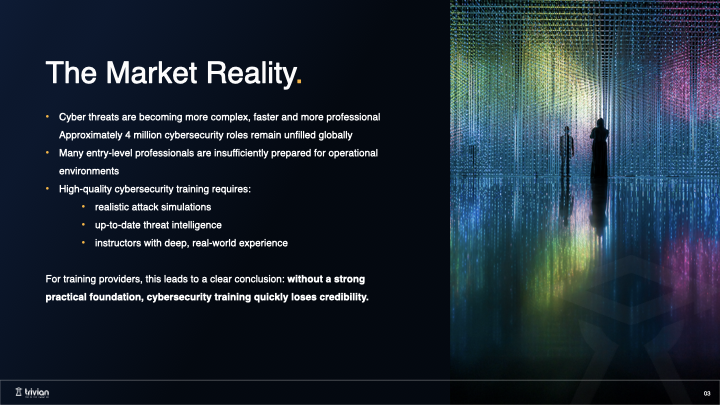
     

    FutureProofing – Trivian | Market reality highlighting increasingly complex cyber threats and approximately 4 million unfilled cybersecurity roles globally

    What early-career cybersecurity roles realistically pay

    Salary expectations strongly influence how students and parents assess education choices. In cybersecurity, entry-level compensation varies by role and region, but starter salaries typically fall in the $40,000–60,000 range, with earnings often rising to $55,000–75,000 after one to two years as practical experience and responsibility increase. Making these ranges explicit helps educators set realistic expectations, anchor enrolment conversations in market reality, and reinforce the commercial credibility of outcome-driven programmes.

    • Entry-level cybersecurity salaries typically range from $40,000–60,000 globally, depending on role and region
    • Salary progression to $55,000–75,000 within one to two years is common as practical experience increases
    • Earnings vary by geography, while global demand for junior cybersecurity roles remains strong, with persistent talent shortages worldwide
    • Transparent salary ranges help educators anchor enrolment discussions in verifiable labour-market outcomes
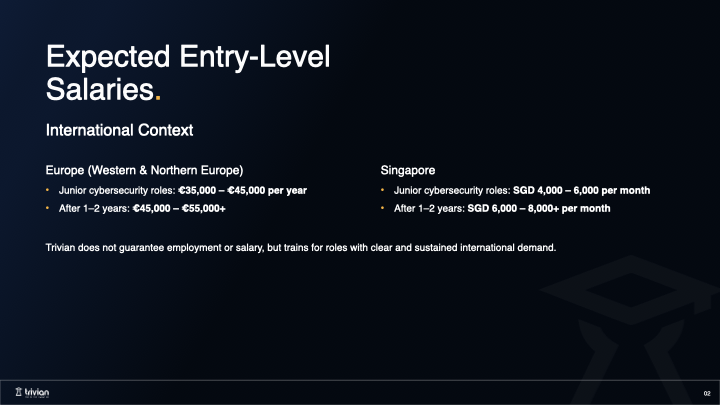
    FutureProofing – Trivian | Expected entry-level cybersecurity salaries showing international context with Europe at €35,000–€45,000 per year and Singapore at SGD 4,000–6,000 per month, rising after 1–2 years

    Educator & Commercial Rationale

    This section explains why operationally aligned cybersecurity programmes outperform theory-led offerings commercially.

    For educators, programme credibility is not just academic — it is commercial. Institutions are under increasing pressure to demonstrate that their programmes translate into faster employability, lower employer onboarding friction, and clear operational value. Trivian is positioned as a portfolio extension that strengthens commercial relevance and employer confidence.

    Why employers value programmes that deliver job-ready graduates

    Employers increasingly expect graduates to contribute quickly, not spend months ramping up. In cybersecurity, operational readiness is as critical as academic knowledge. Programmes that expose learners to real tools, workflows, and decision-making scenarios reduce onboarding friction and are viewed as more credible by employers. For educators, this directly strengthens employability outcomes and the commercial performance of the portfolio.

    • Graduates are expected to be productive faster, with less employer-led onboarding
    • Operational exposure during education reduces post-hire ramp-up time
    • Employers value programmes aligned with real security workflows and tools
    • Faster readiness increases employer confidence and repeat hiring from the same educator

    FutureProofing – Trivian | Clear commercial promise showing reduced ramp-up time from months to weeks through operationally aligned cybersecurity training

    What employers expect — and why it drives enrolment

    In cybersecurity, enrolment decisions are increasingly driven by how clearly programmes reflect real employer expectations. Prospective students — and especially their parents — are no longer persuaded by generic promises of “future opportunities.” They look for education that mirrors how organisations actually hire, onboard, and assess junior talent. Making these expectations explicit reduces decision-time uncertainty and strengthens programme credibility at the point of enrolment.

    • Prospective students enrol faster when programmes clearly align with real employer requirements
    • Parents gain confidence when education is positioned against practical job readiness, not theory alone
    • Transparent links between learning outcomes and workplace expectations reduce enrolment hesitation
    • Employer-aligned programmes stand out more clearly in competitive course comparisons
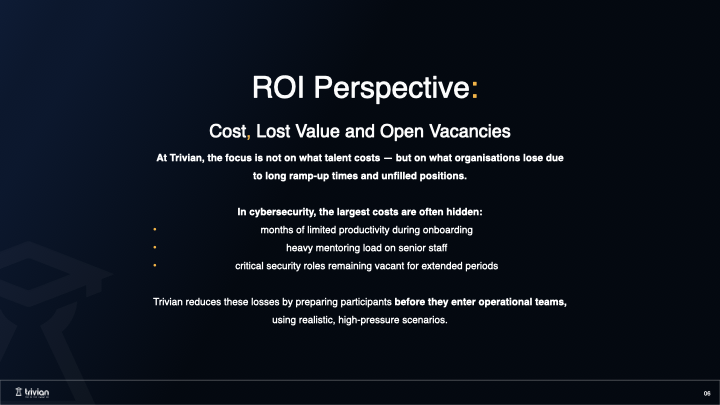
    FutureProofing – Trivian | Clear commercial promise highlighting reduced ramp-up time from months to weeks, shorter onboarding periods, reduced dependency on senior staff and faster return on salary investment

    Why employer cost realities directly influence student enrolment decisions

    When employers evaluate junior cybersecurity hires, salary is only part of the equation. Ramp-up time, productivity loss, and senior staff involvement during onboarding materially affect hiring decisions. These hidden costs increasingly shape how employers assess candidates — and, in turn, how students and parents judge the value of education programmes. Educators who can clearly articulate how their programmes reduce ramp-up and employer risk are better positioned to convert interest into enrolments.

    • Junior cybersecurity hires typically require 4–6 months to reach full productivity
    • Extended ramp-up periods can cost employers $22,000–33,000 per hire before full contribution
    • Programmes that shorten ramp-up to 1–1.5 months materially reduce early productivity loss
    • Clear employer cost logic helps educators demonstrate graduate value more convincingly during enrolment discussions
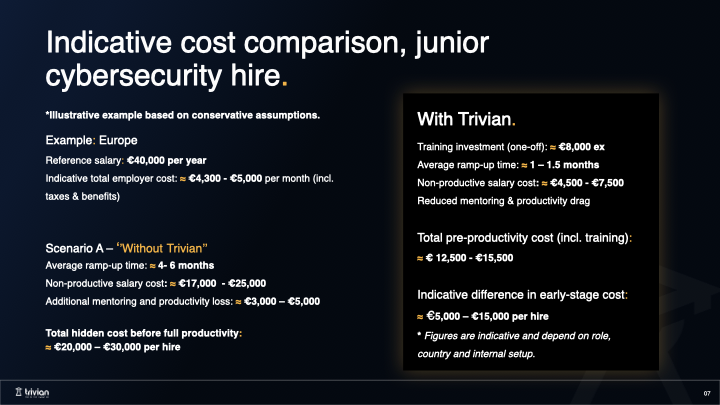
    FutureProofing – Trivian | Indicative cost comparison for a junior cybersecurity hire in Europe showing reference salary of €40,000 per year, ramp-up of 4–6 months without Trivian versus 1–1.5 months with Trivian, and indicative early-stage cost difference of €5,000–€15,000 per hire

    Why vacancy costs strengthen the case for job-ready programmes

    For employers, unfilled cybersecurity roles create immediate operational and financial strain for employers. Work is delayed or outsourced, pressure increases on existing teams, and organisational risk compounds over time. In practice, vacancy periods and slow ramp-up cycles — often measured in months rather than weeks — materially influence how employers value junior candidates and, by extension, how students and parents assess education programmes.

    • Prolonged vacancies increase employer urgency for job-ready junior talent
    • Programmes linked to faster hiring and ramp-up are easier to position during enrolment
    • Clear vacancy-impact narratives strengthen credibility with parents and sponsors
    • Job-ready positioning supports premium perception without competing on price
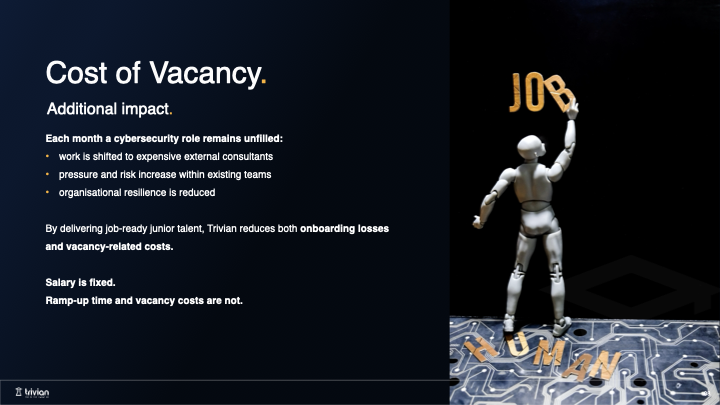
    FutureProofing – Trivian | Cost of vacancy highlighting additional impact of unfilled cybersecurity roles, including reliance on external consultants, increased pressure on existing teams and reduced organisational resilience

    Proof & Credibility


    Trivian’s programmes include a final “ready-to-respond” assessment based on realistic operational scenarios. Participants are evaluated on decision-making under pressure, correct use of security tooling, threat prioritisation, and adherence to operational procedures. This methodology has been applied at scale (5,000+ trained professionals) and is designed to demonstrate real-world readiness — not just theoretical knowledge.

    Operational readiness proven through real-world assessment

    Credibility in cybersecurity education is earned by showing how participants perform under realistic conditions. The programmes include a final “ready-to-respond” assessment based on realistic operational scenarios, measuring whether participants can operate effectively in real security environments. The methodology has been applied at scale, with 5,000+ trained professionals worldwide, and is reinforced by employer references including Israel Aerospace Industries, Cynet, Reblaze, Trustnet, and Experis.

    • Scenario-based ready-to-respond assessment under realistic conditions
    • Evaluation of decision-making under pressure and threat prioritisation
    • Practical validation of operational readiness in live security contexts
    • Programmes validated through use by recognised employers and organisations
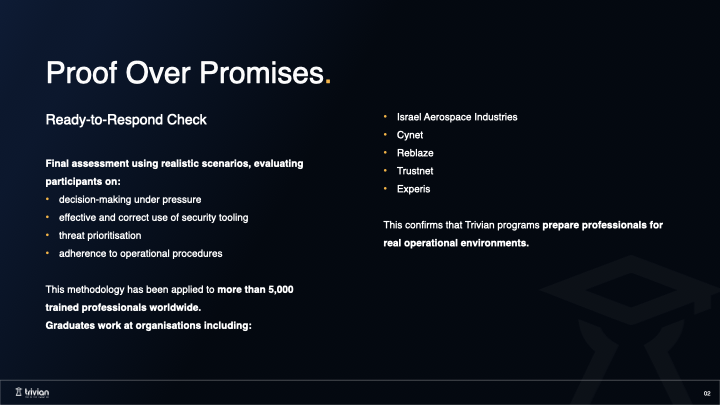
    FutureProofing – Trivian | Proof over promises showing scenario-based ready-to-respond assessment, evaluation under pressure and validation through use by recognised organisations including Israel Aerospace Industries, Cynet, Reblaze, Trustnet and Experis

    Globally recognised alignment with employer-recognised security ecosystems

    Employers increasingly look beyond individual certificates and assess whether programmes align with the actual technology stacks and security environments used in practice. Education that reflects globally recognised ecosystems signals relevance, seriousness, and employability — directly influencing student and parent confidence at the point of enrolment.

    • Alignment with widely adopted platforms including Google Cloud, AWS, Azure, Cisco, LPI, and CompTIA
    • Practical preparation for industry-recognised certifications without over-indexing on exam-driven teaching
    • Clear signalling that learning outcomes map to real employer environments, not abstract theory
    • Stronger perceived credibility for educators offering internationally relevant programmes
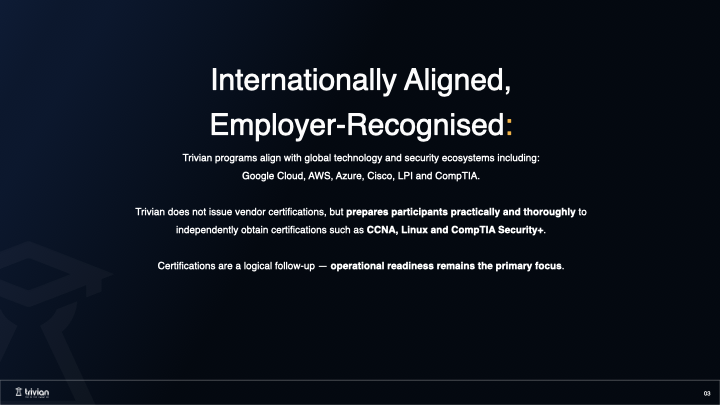
    FutureProofing – Trivian | Internationally aligned, employer-recognised cybersecurity training aligned with Google Cloud, AWS, Azure, Cisco, LPI and CompTIA, with operational readiness prioritised over vendor certification

    Programme Portfolio & Outcomes for Educators


    This section outlines how Trivian’s programmes can be added to an educator’s portfolio as outcome-driven offerings. Programmes are designed to be commercially attractive, operationally relevant, and simple to deploy without structural or curriculum changes.

    Outcome-driven programmes that integrate into an existing portfolio

    Offering modular programmes that educators can introduce individually or combine into clear pathways. Each programme has a defined scope and outcome, making it easy to position alongside existing courses without structural or curriculum changes.

    • Modular programmes that can be offered standalone or stacked
    • Clear progression from entry-level to advanced capabilities
    • Designed for employability, upskilling, and specialisation
    • Easy to position for different learner profiles
    FutureProofing – Trivian | Outcome-driven cybersecurity programmes designed to extend an educator’s training portfolio with modular, stackable cyber resilience programmes

    Cybersecurity training rooted in intelligence and defence operations

    Trivian’s programmes are designed and delivered by senior cybersecurity professionals with operational backgrounds in intelligence and defence environments. The focus is not academic theory, but preparing participants to perform under real-world pressure, using the tools, workflows, and decision-making required in live security contexts. For educators, this translates into programmes that employers recognise as operationally credible and job-relevant.

    • Programmes informed by real intelligence and defence cyber operations
    • Training built around realistic attack simulations and live scenarios
    • Assessment focused on decision-making, execution, and operational discipline
    • Scenario-based learning aligned with current threat environments
    • AI applied as a practical component of modern cyber operations
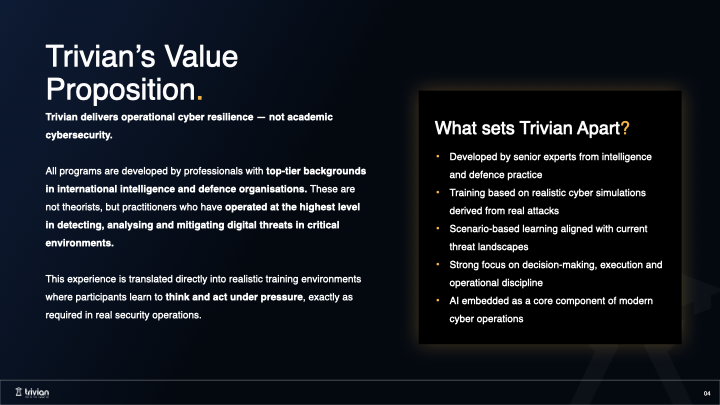
    FutureProofing – Trivian | Value proposition highlighting operational cyber resilience training delivered by senior intelligence and defence practitioners, using realistic simulations, scenario-based learning and AI embedded in modern cyber operations

    Portfolio-ready cybersecurity offerings

    Programmes are modular, clearly scoped, and easy to position within an existing education portfolio. Each is designed around concrete roles and outcomes, allowing educators to present clear value propositions with minimal operational complexity.

    • Mix of flagship programmes (≈15 weeks/~500 hours) plus short-format specialist courses (≈50–150 hours)
    • Clear duration, intensity, and outcome framing to support marketing and sales
    • Programmes aligned with current employer demand across cybersecurity and AI-enabled roles
    • Can be offered standalone or stacked alongside existing courses
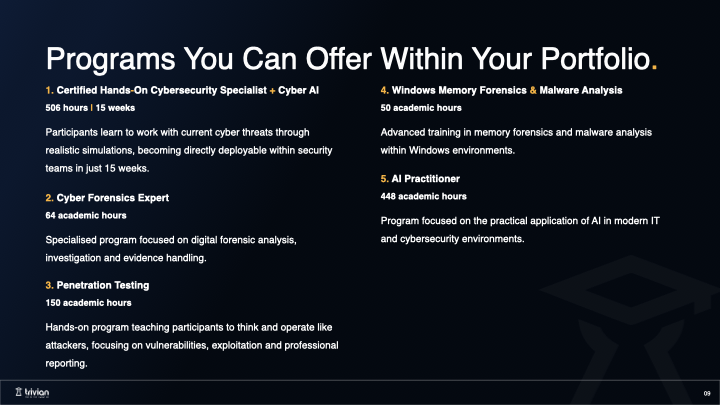
    FutureProofing – Trivian | Portfolio-ready cybersecurity programmes including certified hands-on cybersecurity specialist with cyber AI, cyber forensics expert, penetration testing, Windows memory forensics and malware analysis, and AI practitioner training

    Employer-led programmes for strengthening existing cybersecurity teams

    Alongside individual enrolments, Trivian’s programmes can also be delivered directly to organisations seeking to strengthen existing cybersecurity teams. This enables educators to address employer-led upskilling and reskilling demand in parallel with student-focused offerings — without repositioning their core portfolio..

    • Suitable for employer-sponsored training within organisations
    • Applied to existing teams, junior hires, and transitioning professionals
    • Primarily online delivery, with on-site components for larger cohorts where required
    • Clear assessment and outcome validation aligned with operational roles
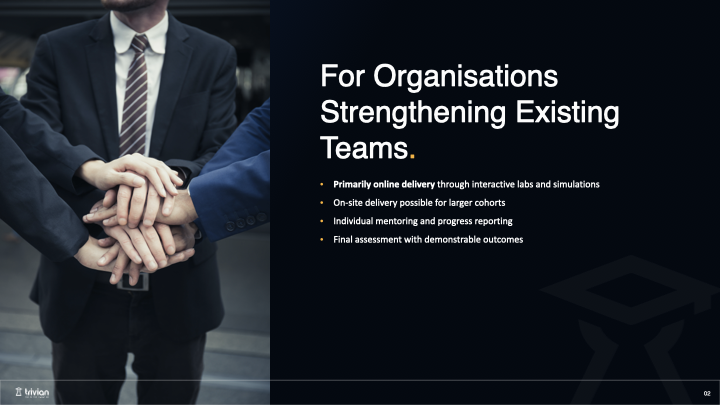
    FutureProofing – Trivian | In-company cybersecurity training for organisations strengthening existing teams through online labs and simulations, optional on-site delivery, mentoring and final assessment with demonstrable outcomes
     

    Get in Touch

    Explore how Trivian can strengthen your portfolio and enrolment proposition


    This is not a speculative add-on. It is a proven, employer-aligned cybersecurity training capability designed to strengthen enrolment appeal, portfolio credibility, and commercial performance.

    If you are evaluating how to extend your offering with job-ready cybersecurity programmes — without rebuilding curriculum or operational complexity — this is a conversation worth having.


    Get in Touch

    Frequently Asked Questions


    What problem does this training set-up solve for training providers and educators?

    It enables educators to offer employer-aligned, job-ready training without rebuilding their curriculum from scratch. The Trivian platform provides ready-to-deploy programme structures, reducing time, risk, and operational overhead.

    Who is this designed for — training providers, universities, or professional education organisations?

    This is designed for professional training providers, private educators, and universities that want to strengthen employability outcomes and market relevance. It is particularly relevant for organisations looking to introduce job-ready cybersecurity training using a leading platform such as Trivian, while retaining flexibility in how programmes are positioned and delivered.

    How does this improve employability and workforce readiness in practice?

    Learners develop skills that align with real cybersecurity roles and employer expectations, not abstract theory. Training focuses on applied, job-relevant capabilities, enabling learners to enter a market where demand for cybersecurity skills continues to expand with practical competence and credible, in-demand skills.

    How do these programmes support Future of Work skills and employer demand?

    They focus on skills and roles that employers are already hiring for and expect to remain critical as technology and work practices evolve. By linking training content to real job requirements, educators can ensure learners develop capabilities that stay relevant as the nature of work continues to change.

    What outcomes can educators expect when introducing these programmes?

    Educators gain access to up-to-date, intelligence-grade cybersecurity training through the Trivian platform, removing the need to track a fast-moving field independently.

    How long does it typically take for an educator to implement this training set-up?

    Implementation timelines vary depending on the organisation and context, but the set-up is designed to be rolled out within a matter of months.

    What needs to be in place at a training institute or university to get started?

    Very little beyond an existing training operation and basic programme delivery capability. The programmes are designed to be introduced alongside current offerings, using predefined structures and content, without requiring new curriculum development or significant operational change.

    Can these programmes be integrated into existing programmes, courses, or curricula?

    Yes. The programmes are modular and clearly scoped, allowing educators to introduce them as standalone offerings or position them alongside existing courses. This makes it possible to extend an education portfolio without restructuring current programmes or curricula.

    How flexible is this training set-up across regions, markets, or learner profiles?

    The Trivian programmes are modular and role-focused, allowing educators to position them for different learner profiles, such as entry-level participants, career switchers, or upskilling professionals. This gives providers room to tailor their offering to different audiences while keeping the programme structure consistent.

    How does this support revenue growth for training providers and educators?

    By enabling educators to offer credible, up-to-date cybersecurity programmes in a high-demand field, the Trivian platform helps strengthen market positioning and market appeal. This makes it easier to attract interest, support enrolment decisions, and expand the offer into an area where demand is strong and persistent.

    How does this align with Future of Work requirements without adding operational complexity?

    It aligns training with roles and skills that are already shaping the Future of Work, while keeping the structure modular and clearly defined. Using a platform such as Trivian allows educators to stay current in a fast-moving field like cybersecurity without continuous content redevelopment or structural change.

    About


    Topics:
    Future of Work · Cybersecurity · Professional Training · Employability · Workforce Readiness
    Updated:
    January 2026
    Author:
    JJ (Hans) VAN DER LAAN
    Founder, FutureProofing · Hands-on market entry, financing & strategic growth
    Company:
    FutureProofing Ecosystem
    Scaling market-ready education and go-to-market execution across selected platforms and partners, including Trivian
    Contact:
    We’d be glad to hear from you:get in touch
    Tags:
    future-of-work deck-to-page cybersecurity-training professional-training workforce-readiness employability 

    Get In Touch