<img alt="" src="https://secure.inventiveinspired7.com/792353.png" style="display:none;">
FPCO 9-3

European market entry:
From setup to revenue 


Bridging the gap between success in Asia and the commercial execution Europe requires
Hands-on execution for Asian companies moving into Europe

Reality of European Execution


Expansion often starts with promising signals: early traction and market interest. But converting that momentum into revenue quickly exposes the gap between 'market interest' and local execution.

Friction occurs when sales expectations outpace delivery capability, local partnerships, and operational support. Internal teams are often forced to 'make it work' alongside existing priorities, creating significant pressure while the organisation is already in motion.

This deep dive explores what it actually takes to convert European traction into revenue. It also highlights where the pressure tends to build inside organisations when expansion decisions are made under real-world revenue constraints.

Summary

The commercial execution required to turn European market potential into signed deals.

Access2Europe provides a high velocity, hands-on path for organisations across Greater Southeast Asia (GSEA) to build repeatable revenue in Europe. We bridge the gap between initial market interest and local commercial reality by managing the outreach, regulatory alignment, and infrastructure required to scale.

  • Direct revenue focus – moving beyond initial meetings into pipeline, closing, and signed contracts
  • Regional market access – navigating the four distinct economic blocks of Europe through a proven, structured approach
  • On-the-ground execution – providing the local presence and senior involvement needed to open doors and close complex deals
  • Technical and regulatory setup – aligning with MDR, GDPR, the AI Act, and other CE standards to remove growth friction
  • Outcome-linked delivery – a commercial model designed to share risk and scale directly with your revenue growth
This is not a speculative market entry exercise. Access2Europe offers a direct, execution-led service designed to turn GSEA ambition into European commercial results.


Contents


    European Expansion Reality

    Where early traction meets the realities of European execution.

    Early signals in European market entry can look promising — interest from buyers, good meetings, and early traction. But once revenue expectations appear, pressure builds quickly. Sales targets are set before delivery, support, and local capacity are fully in place. At that point the real work begins: turning early traction into repeatable revenue.

    Why early demand in Europe doesn't always translate into revenue

    European market entry often starts with promising demand. But that demand quickly turns into revenue expectations before the organisation is ready to deliver.

    • Early European demand can quickly turn into revenue commitments that the organisation is not ready to fulfil
    • Expansion may proceed before delivery capability and local capacity are aligned — creating operational strain, particularly in high-barrier sectors like Green Energy, MedTech, and Advanced Manufacturing
    • At that point, leadership must decide whether to push through or pull back
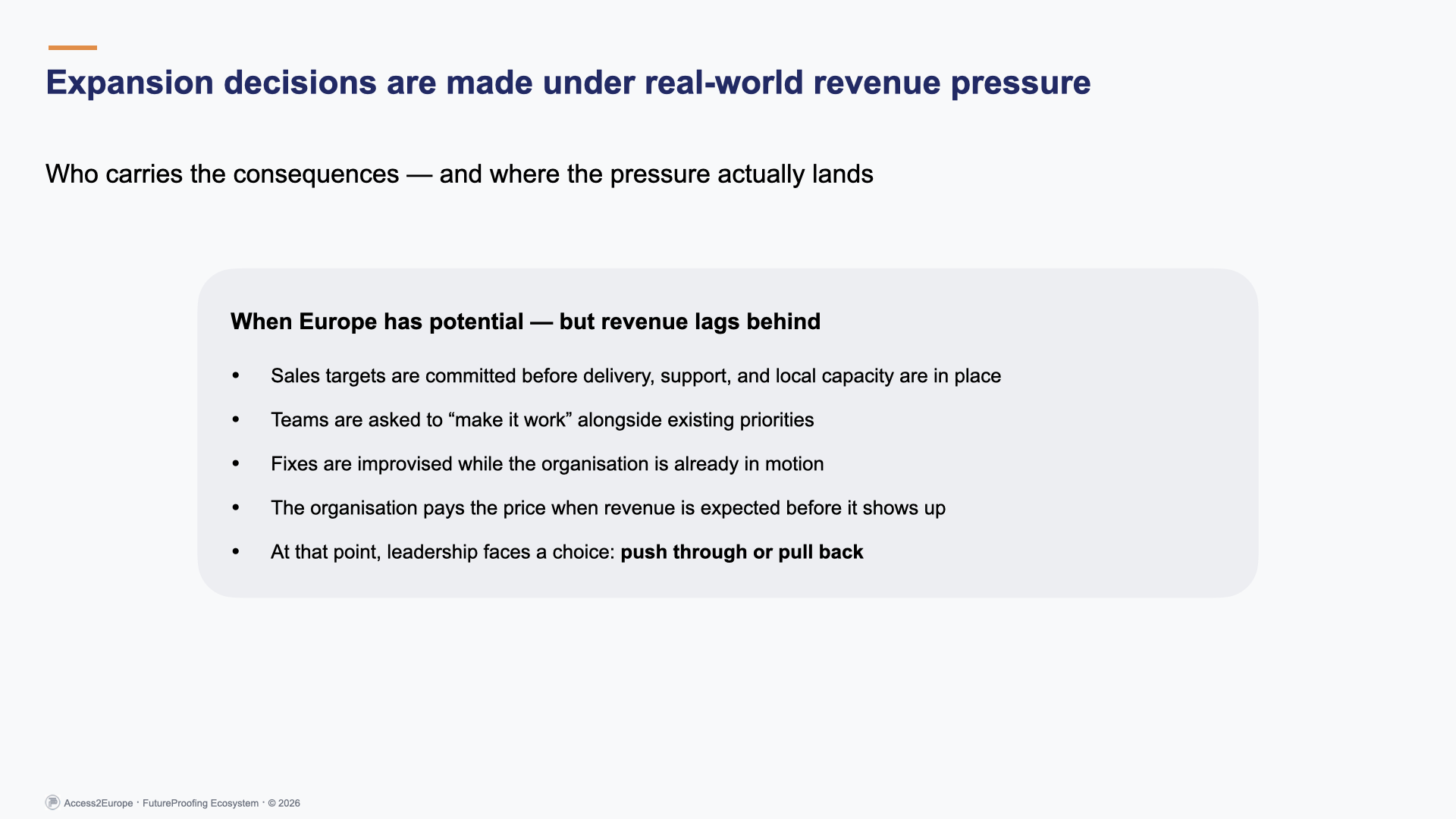
     

    FutureProofing - Access2Europe | Early European demand not translating into revenue due to misaligned delivery readiness, capacity, and go-to-market execution

    Strategic intent, trajectory, and the cost of delay

    Leaders often identify a gap between where the organisation is now (As-Is) and where it could realistically be (Should-Be). The question then becomes simple: are you missing an opportunity (Opportunity Cost), or will doing nothing create serious problems (Cost of Inaction – CINA)? In a competitive market, hoping to maintain the status quo is rarely a realistic option.

    • Are you missing an opportunity you could pursue? (Opportunity Cost)
    • If nothing changes, will your company run into serious problems? (Cost of Inaction – CINA)
    • Do you believe the current situation is satisfactory and will simply hold? (Status Quo)
    • Which of these situations applies to your company?
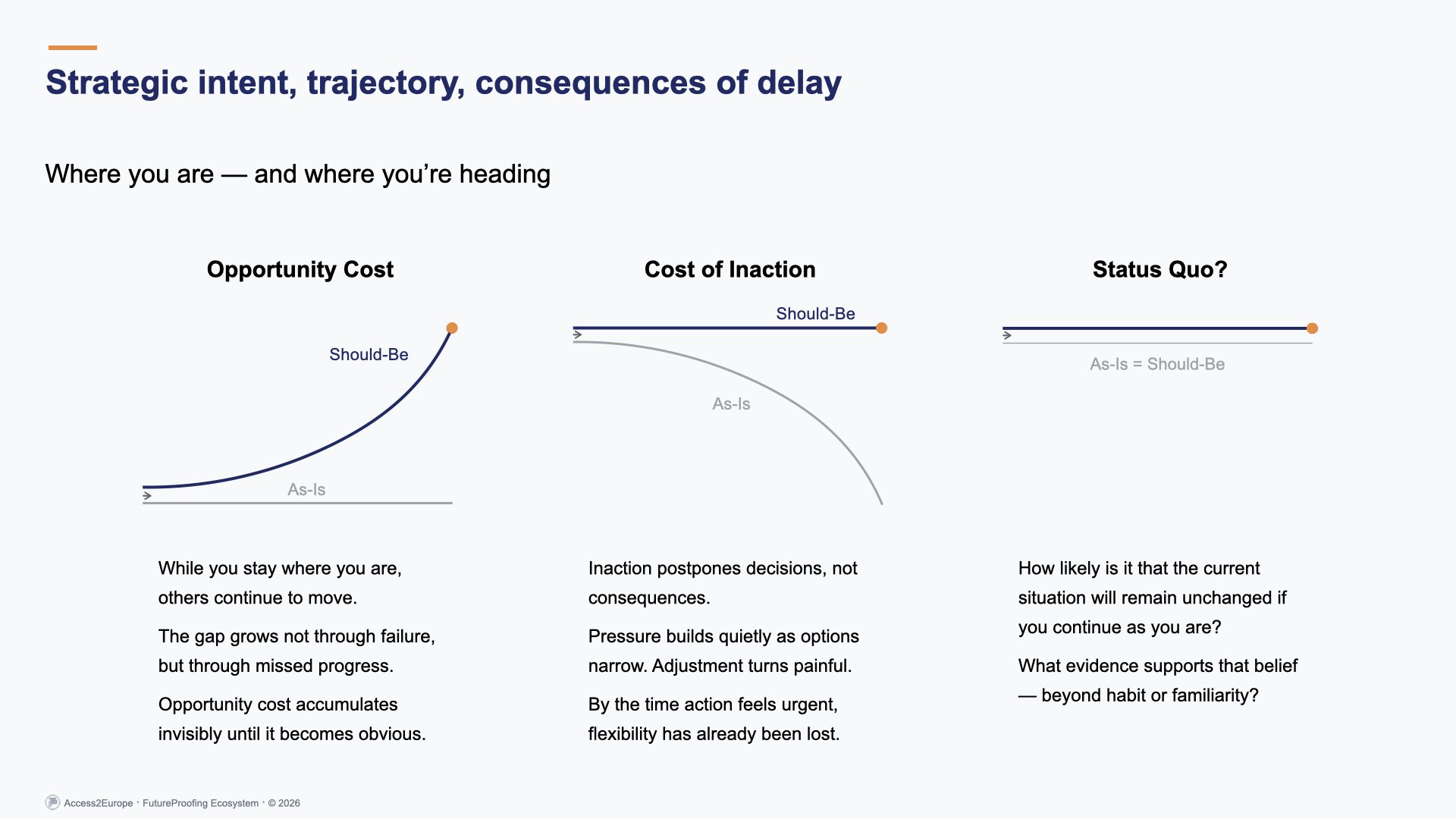
    FutureProofing – Access2Europe | Miller Heiman As-Is vs Should-Be framework for European market entry, showing opportunity cost, cost of inaction, and status quo risk

    From As-Is to Should-Be: the strategic choices behind European expansion

    Moving from the current position to a stronger future state requires a sequence of strategic decisions. The GHOST framework highlights five areas leaders must evaluate when deciding how and where to expand in Europe.

    • GrowthDecide which growth path the company will actively pursue rather than allowing momentum or internal pressure to determine direction
    • HomeAssess whether the home market still offers meaningful growth potential before committing resources to international expansion
    • OuterEvaluate neighbouring markets first, where expansion may be achievable without excessive operational complexity
    • ScaleDetermine which markets can support sustainable scale rather than short-term revenue or isolated wins
    • TargetingChoose deliberately where to focus resources and where not to compete in order to build durable market positions
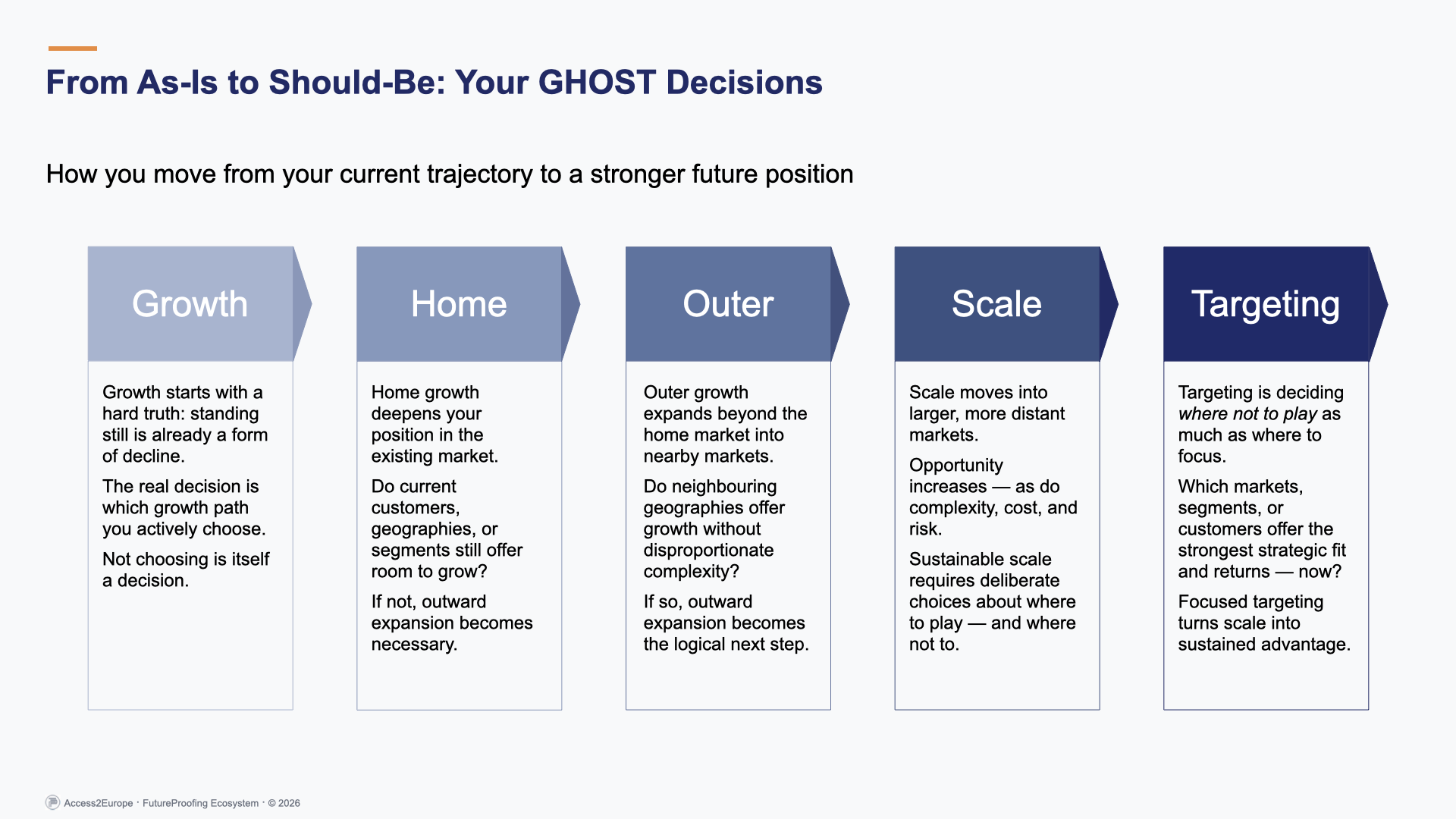
    FutureProofing – Access2Europe | GHOST framework for European market entry decisions: Growth, Home, Outer, Scale, and Targeting

    Europe & Market Approaches

    Targeting decisions in the world’s largest commercial markets.

    Europe is one of the world’s largest and most stable commercial markets. With hundreds of millions of affluent consumers and well-established regulatory systems, it offers a level of scale few regions can match. However, Europe is not a single homogeneous market. Companies that succeed recognise its internal structure and make deliberate choices about where to enter first and how to expand across regions.

    Europe’s economic scale is accessed through four regional markets

    Europe’s economic scale — a market of roughly 700 million people and one of the largest economic areas in the world — is typically accessed through four regional clusters, each with its own commercial dynamics. Purchasing power, regulatory maturity, and buyer expectations vary across the continent, requiring companies often build their European presence step by step across regions.

    • Western Europe – largest concentration of major economies and affluent markets in the European Union
    • Nordic countries – smaller populations but among the highest in purchasing power per capita globally
    • Central & Eastern Europe – large population base with fast-developing economies integrated into European supply chains
    • Southern Europe – significant population scale and important consumer markets across the Mediterranean economies
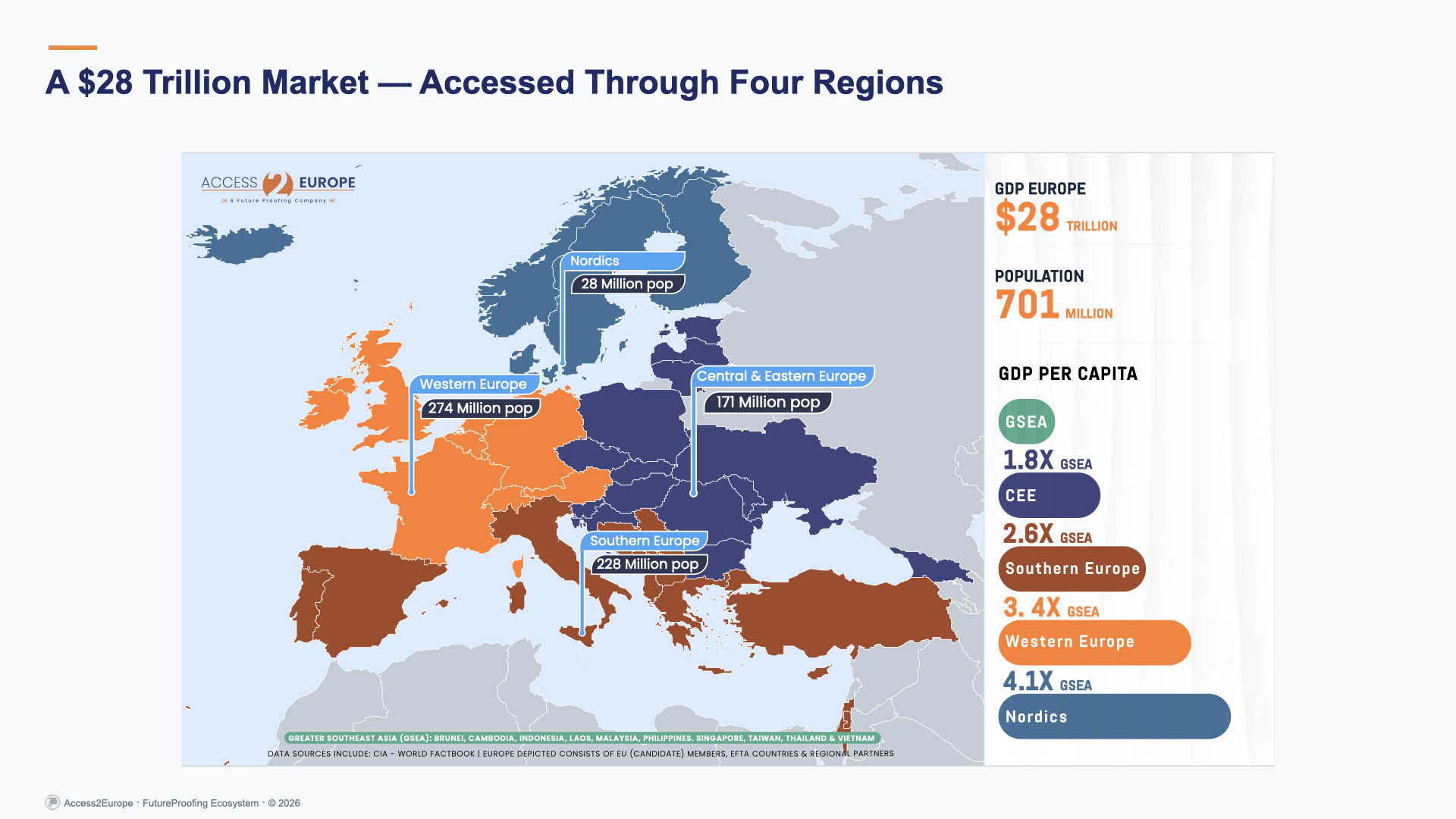
    FutureProofing – Access2Europe | Map of Europe showing four regional market clusters (Western Europe, Nordics, CEE, Southern Europe) within a ~$28T economy of ~700M people

    Europe offers scale, purchasing power, and predictable demand

    Europe is a demanding but highly rewarding market for companies that align with its standards and buyer expectations. Rather than opportunistic entry, success typically comes from structured execution, clear positioning, and the ability to operate within established commercial and regulatory frameworks.

    • Operating within European standards strengthens credibility across multiple markets
    • Purchasing power is concentrated in clearly defined and demanding buyer segments
    • Demand patterns are relatively stable in mature European economies
    • A largely unified market structure enables scalable commercial expansion
    • A broad middle class supports sustained demand for higher-value offerings
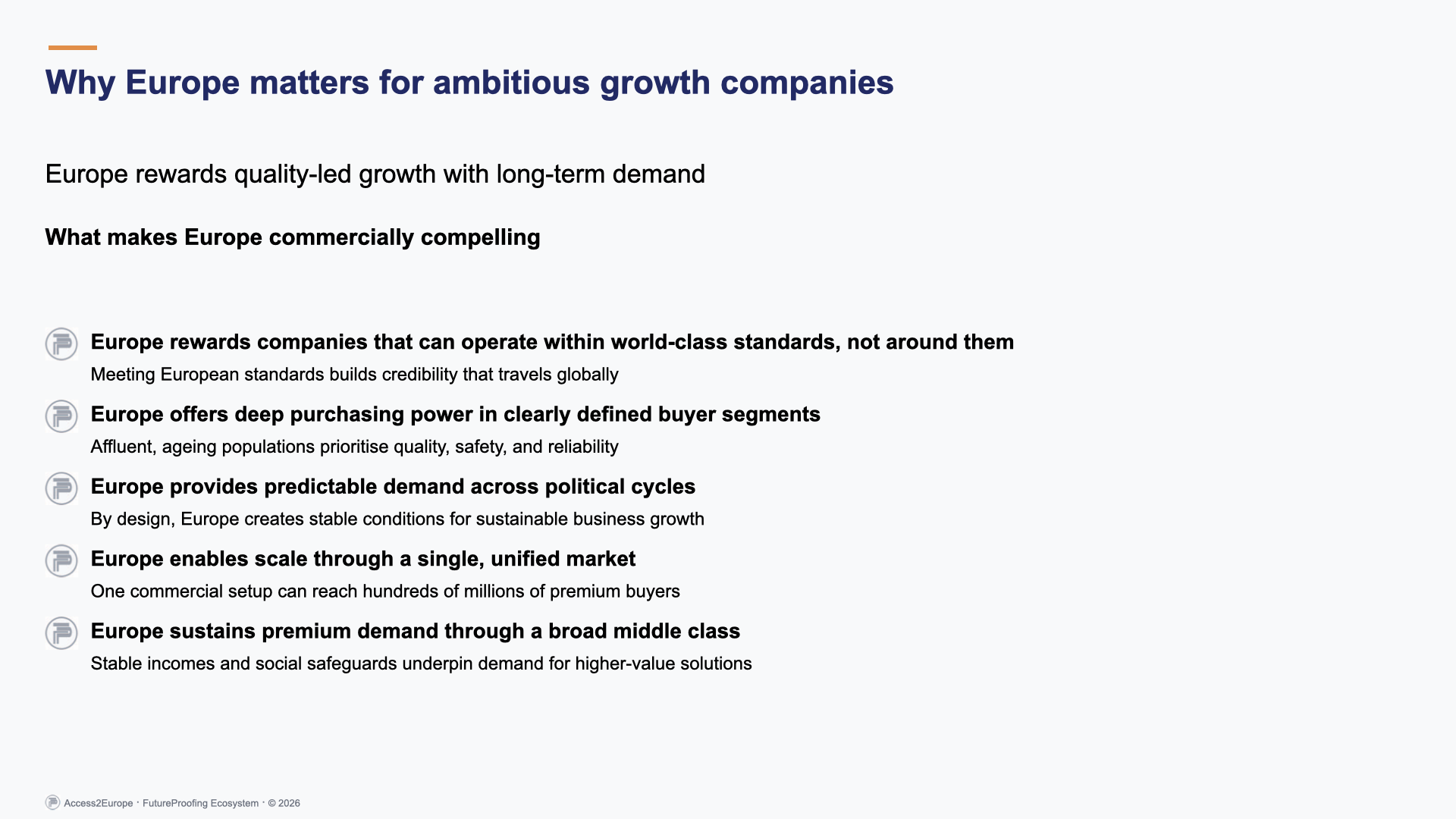
    FutureProofing – Access2Europe | European market characteristics highlighting global standard-setting, scale, purchasing power, predictable demand, and unified market structure for growth companies

    Market Entry & Execution

    Growth in Europe depends on making the right go-to-market decisions early — and executing them locally.

    Entering the European market is not an opportunity problem, but an execution one. Many companies struggle because their approach doesn’t match how European buyers and markets actually operate. Success comes down to clear positioning, focused market selection, and disciplined commercial execution.

    How early choices shape European expansion

    Early decisions determine whether Europe builds momentum — or friction. Misalignment with how markets actually operate is the most common cause of stalled growth and operational drag.

    • Define the region you are entering — Europe does not behave as one market
    • Anchor in markets that set commercial and regulatory benchmarks
    • Build a go-to-market model that scales across markets
    • Expand only once traction is proven and repeatable
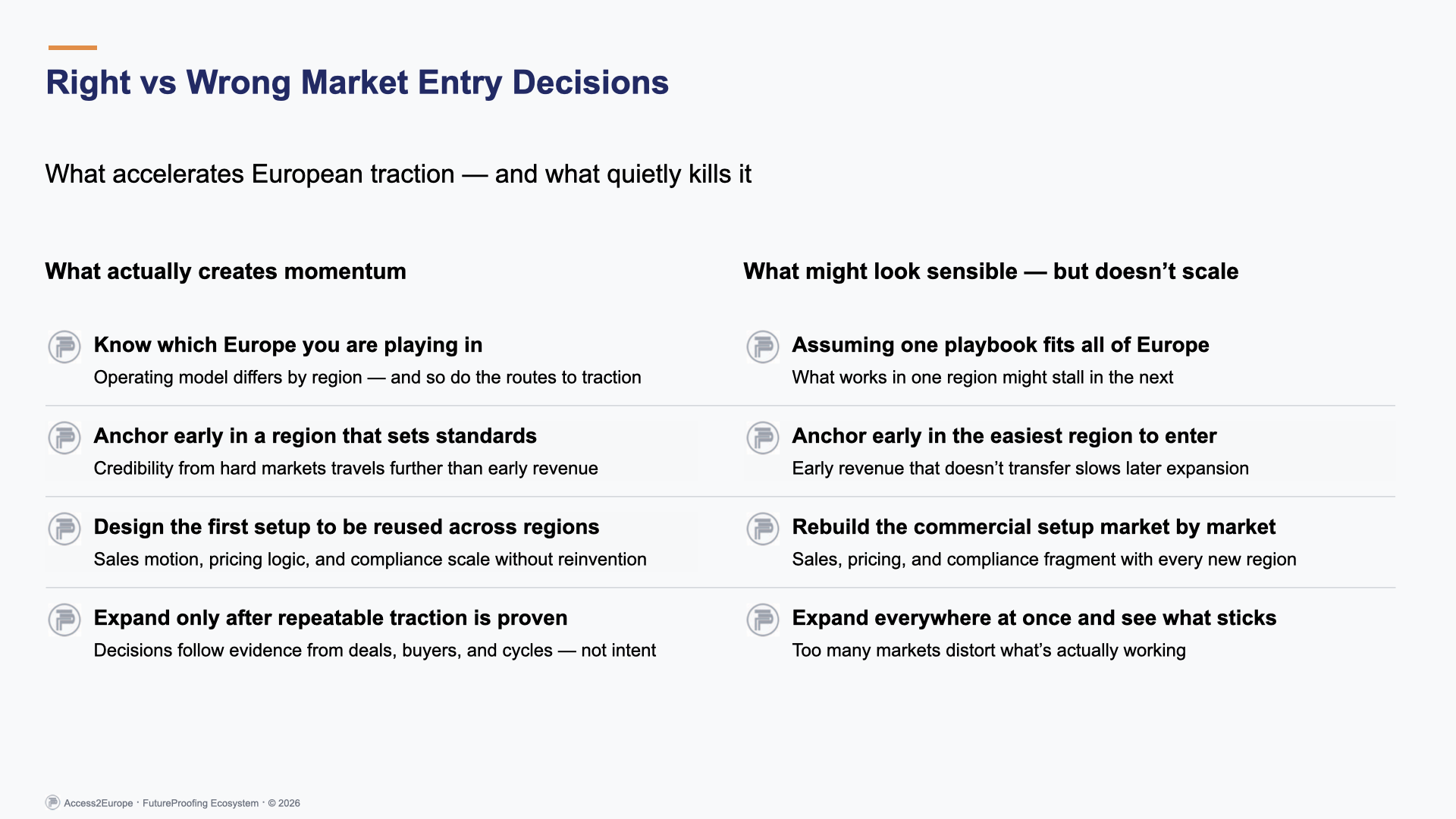
    FutureProofing – Access2Europe | Right vs wrong European market entry decisions, showing how early choices drive scalable traction or create friction across regions

    Turning European opportunity into execution

    Moving from intent to revenue in Europe requires a sequence of structured decisions — not scattered exploration. Progress comes from narrowing focus, validating early, and scaling what works locally.

    • Focus on a small number of priority markets and segments
    • Choose how to enter: build, partner, or buy
    • Test demand through targeted outreach and pilot execution
    • Scale only once traction and commercial viability are proven
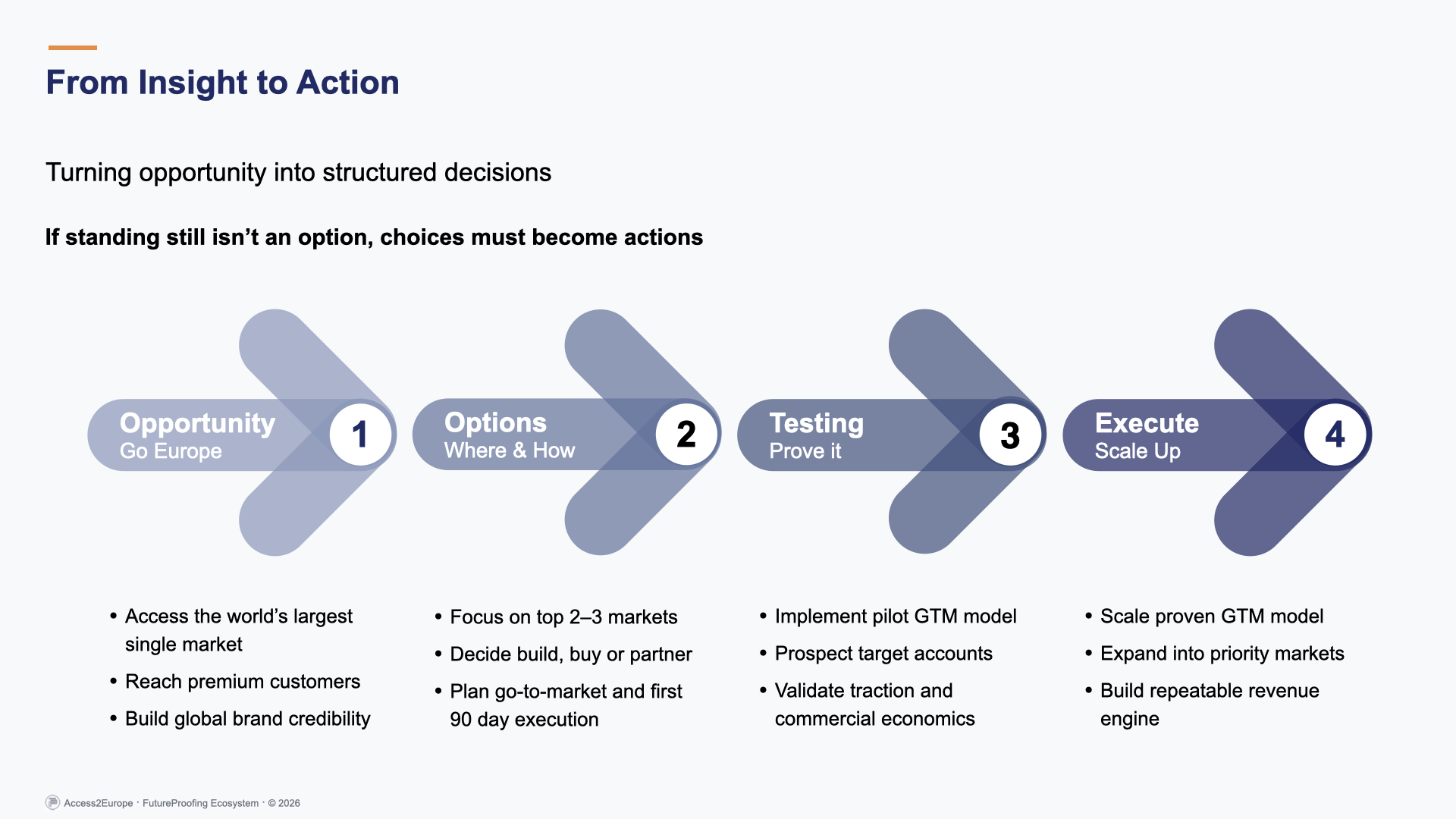
    FutureProofing – Access2Europe | From insight to action framework for European market entry, showing steps from opportunity and market selection to testing, execution, and scaling

    What must be clear before entering European markets

    Many market entry efforts stall not due to lack of demand, but due to unclear fundamentals.
    Before moving forward, key commercial decisions must be made.

    • Define clear buyer personas and priority markets
    • Define value proposition and competitive positioning
    • Align proof points with how European buyers evaluate options
    • Define scope, ownership, and decision-making
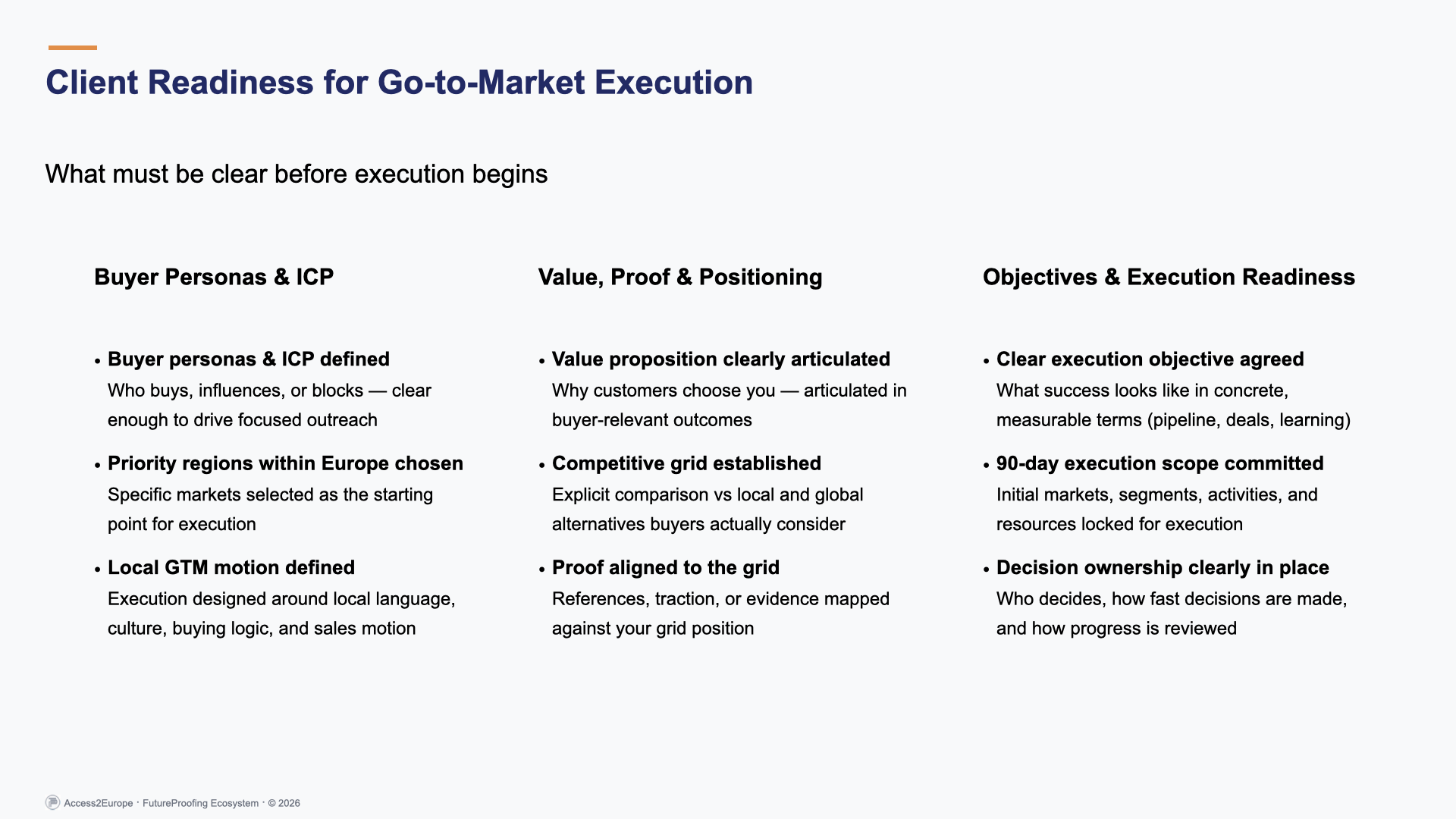
    FutureProofing – Access2Europe | Go-to-market readiness framework for European market entry, covering buyer personas, Ideal Customer Profile (ICP), value proposition, positioning, and execution alignment before launch

    From Market Entry to Signed Deals

    Turning European opportunity into revenue requires engagement, pipeline, and closing.

    Entering Europe only matters if it generates leads and closes deals. That means turning outreach into meetings, meetings into pipeline, and pipeline into revenue. This transition requires a direct, execution-led approach to ensure that initial opportunity results in signed contracts.

    How Access2Europe converts European ambition into revenue

    A staged, hands-on path from first traction to revenue in Europe — moving from validation to shaping, then execution and scale. Each step forces a concrete decision focus and moves you closer to signed deals.

    • Validate where demand is real — and where it is not
    • Shape the few markets and segments that can convert
    • Build a go-to-market approach around those targets
    • Execute by opening conversations with buyers, partners, and channels
    • Scale early wins into repeatable revenue
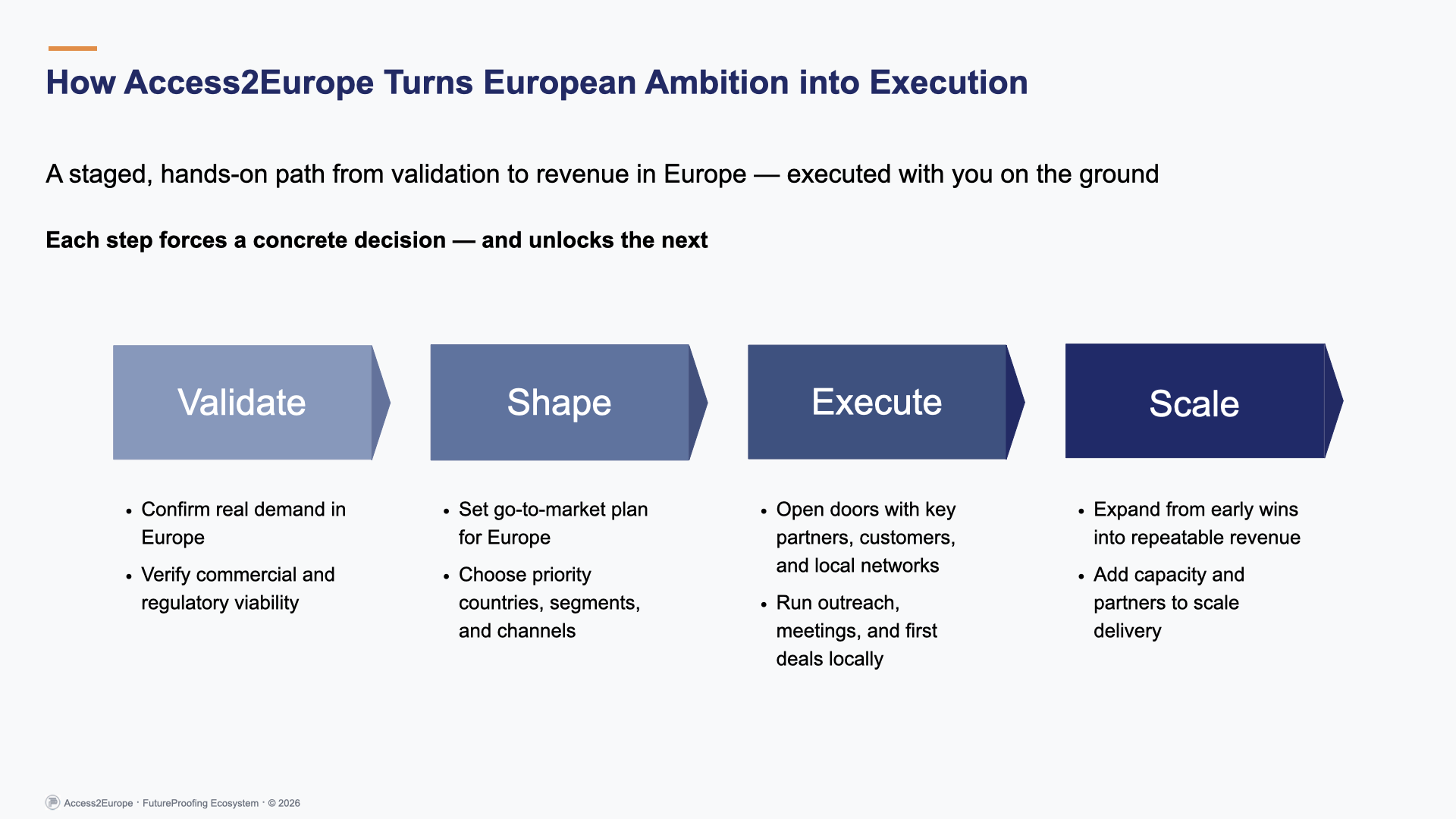
    FutureProofing – Access2Europe | Access2Europe execution model for European market entry, showing stages from validation and shaping to execution and scaling into revenue

    Finance and setup that remove friction in Europe

    Scaling in Europe is not just commercial — it requires the right financial setup and local infrastructure from day one. When structured correctly, this removes delays, supports early traction, and enables faster scaling.

    • Structure funding in line with stage, timelines, and risk profile
    • Align with GDPR, the AI Act, and local regulations
    • Design revenue models that work across European markets
    • Access grants and incentives without slowing progress
    • Establish legal, banking, and operational infrastructure early
    • Bridge local legal, language, and cultural gaps
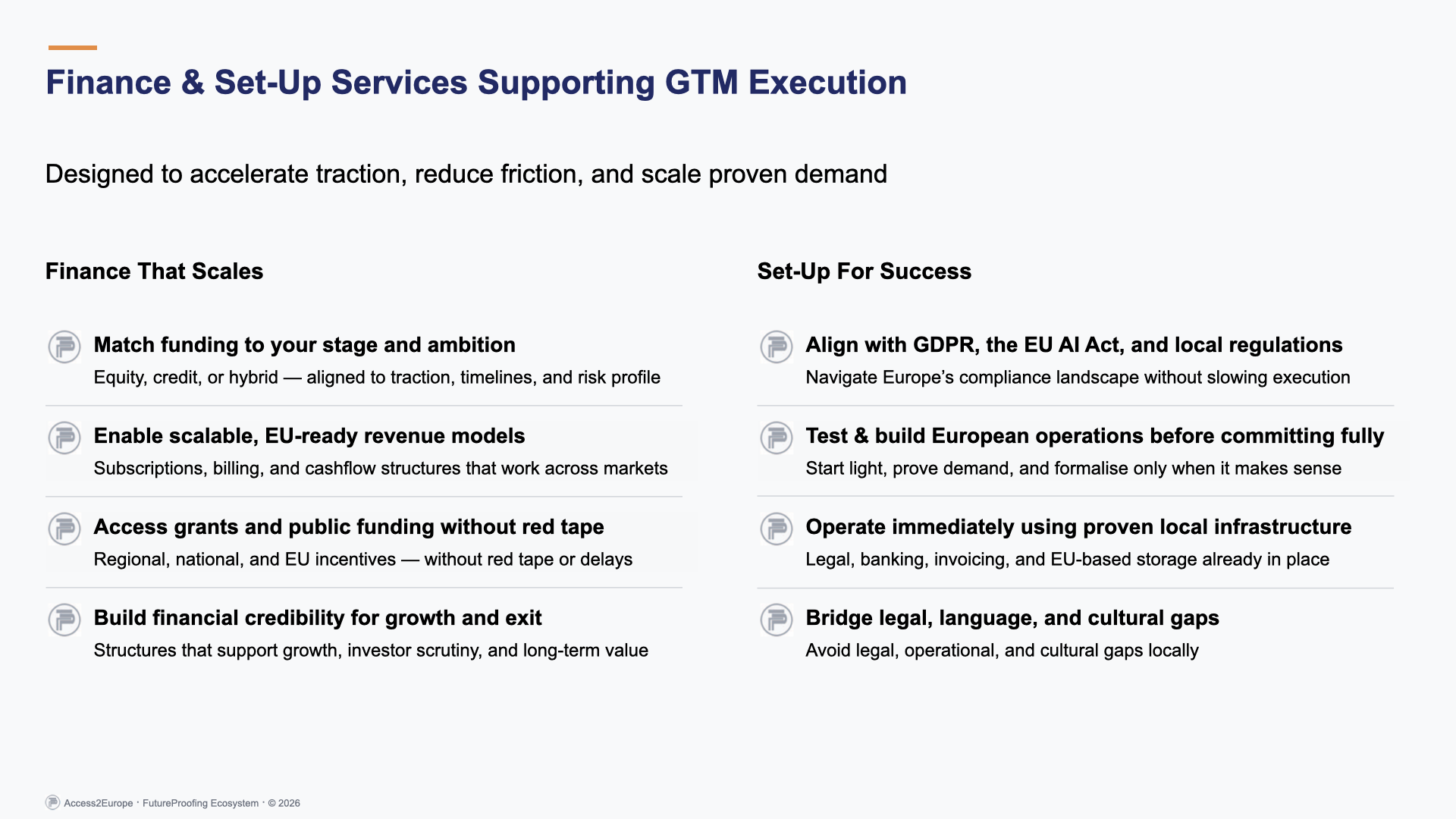
    FutureProofing – Access2Europe | EU market entry setup covering legal entity formation, funding and grants, regulatory compliance, and local infrastructure for compliant commercial scaling

    Access2Europe delivers commercial results across sectors

    European market entry only matters if it turns into leads, deals, and revenue. These examples show how Access2Europe generates traction, partnerships, and commercial outcomes across industries.

    • Launched Industry 4.0 pilots with European manufacturers and OEMs
    • Built retail and eCommerce channels for international brands
    • Secured commercial traction with food-service and catering buyers
    • Rolled out AI-driven solutions with European educators
    • Achieved regulatory approval and launched pilots in smart technologies
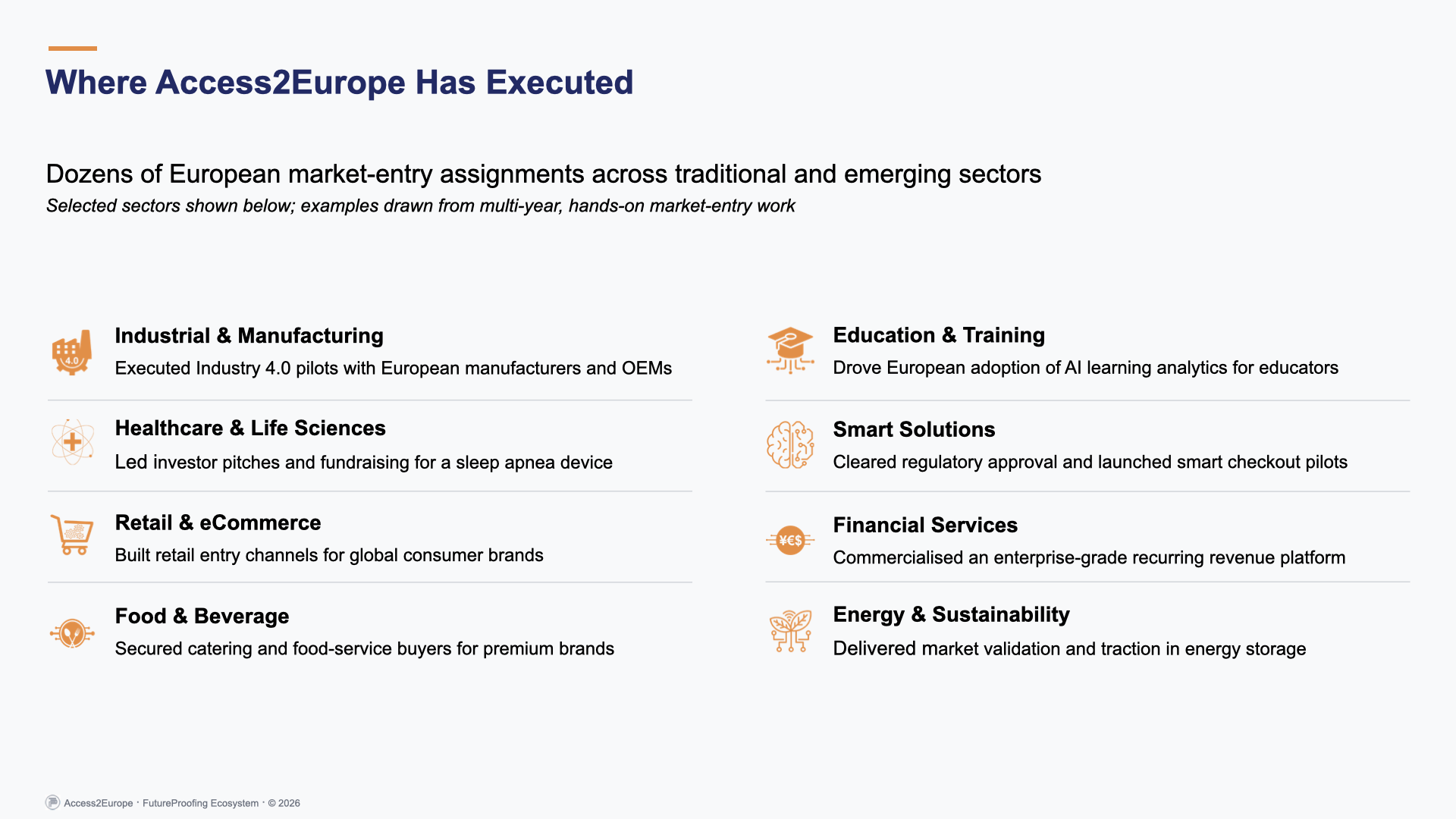
    FutureProofing – Access2Europe | Examples of European market entry execution across sectors, including industrial, healthcare, retail, education, smart solutions, financial services, and energy

    Engagement model and commercial structure

    Execution is structured and tied to outcomes. The model combines ongoing delivery with success-linked upside, focused on building pipeline, closing deals, and generating sustainable revenue in Europe.

    • Ongoing execution through a monthly retainer
    • Success fee tied to pipeline, deals, and revenue
    • Additional execution capacity via time & materials
    • Out-of-pocket costs for travel, events, and local activity
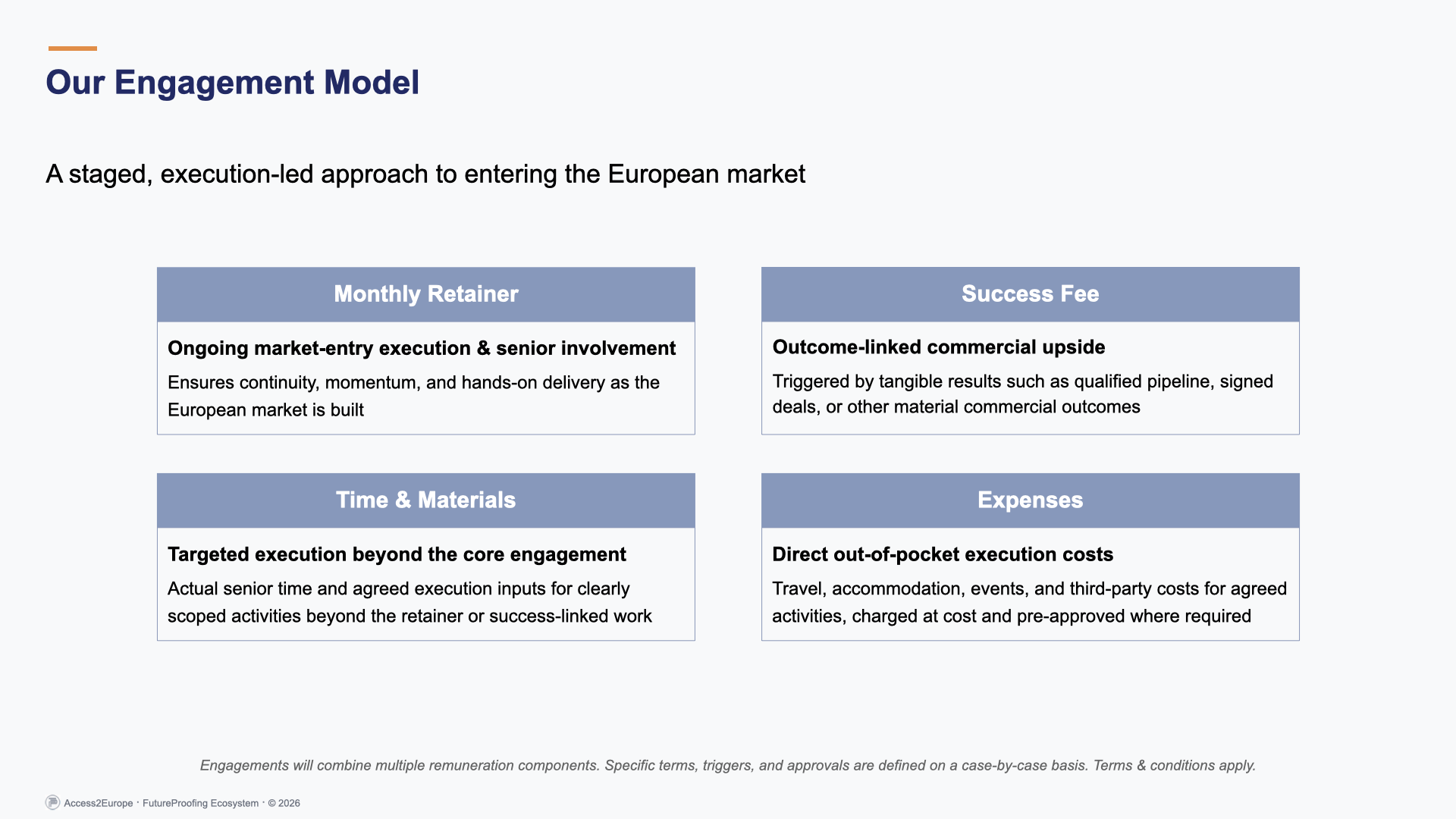
    FutureProofing – Access2Europe | Engagement model for European market entry combining monthly retainer, success fee, time and materials, and execution expenses linked to commercial outcomes

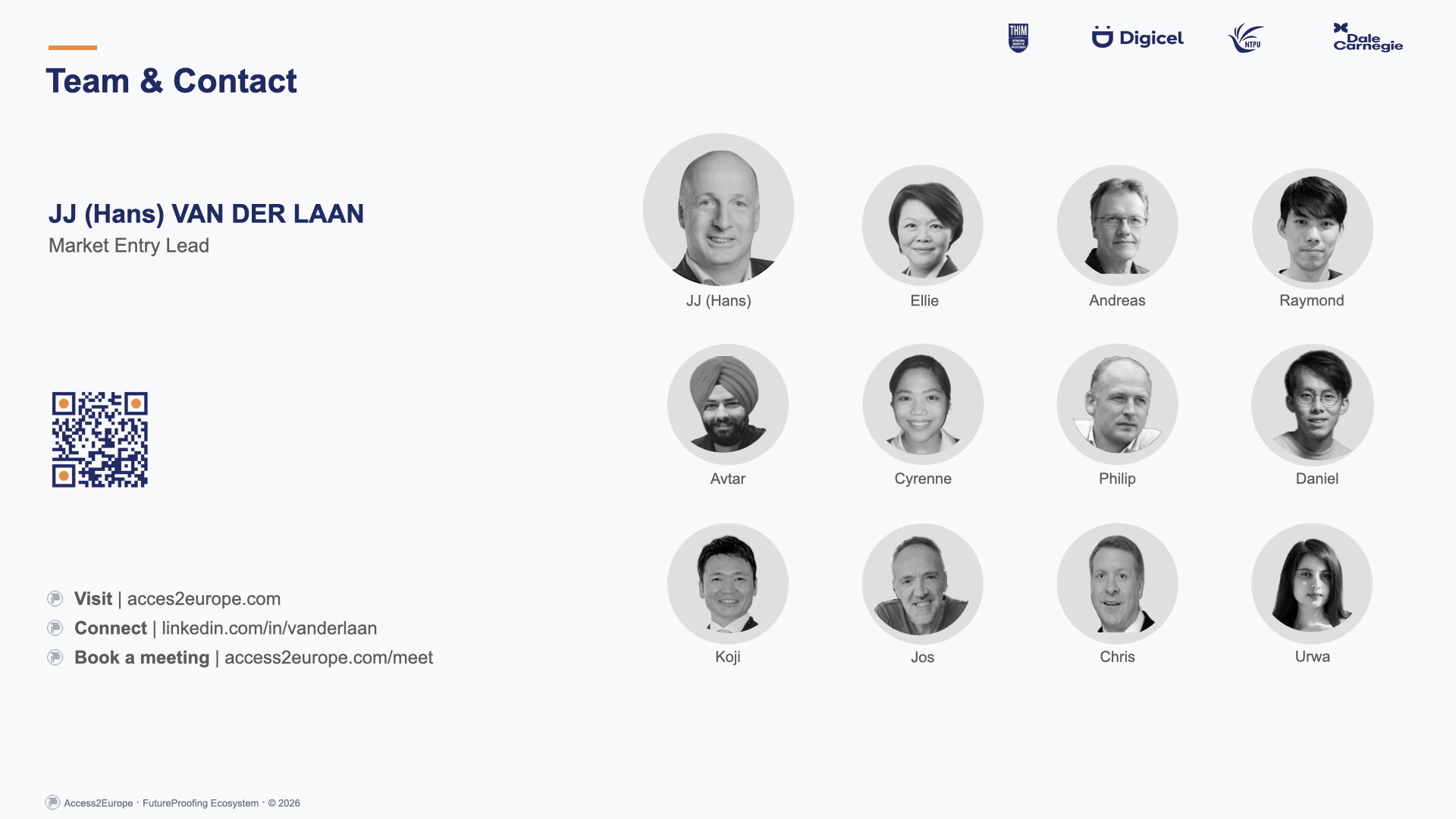
    The team driving market entry in Europe

    A hands-on team across Europe and Asia, led by senior operators, executing outreach, coordination, and local delivery.

    • Senior-led involvement in key accounts and deals
    • Teams across Europe and Asia
    • Coverage across outreach, coordination, and local activity
    • Scales with market, sector, and stage
    FutureProofing – Access2Europe | Team supporting European market entry with senior-led execution across Europe and Asia, including outreach, coordination, and local delivery

    Get in Touch
    Explore how to turn European market entry into pipeline, deals, and revenue.

    This is not a theoretical approach. It is a hands-on, execution-led model focused on delivering commercial results in Europe.

    If you are serious about entering the European market — and moving from ambition to commercial results — we should speak.


    Book a meeting

    Frequently Asked Questions


    How is this different from a standard market entry consultancy?

    Most consultants provide a theoretical study and leave. We are execution partners who stay on the ground to open doors, run meetings, and manage the "last mile" of the deal until revenue is repeatable.

    Do you take a "one-size-fits-all" approach to Europe?

    No. Europe is four distinct regional blocks. We help GSEA companies and organisations anchor in the region that sets the highest regulatory benchmarks first so their credibility scales across the rest of the continent.

    Which sectors do you specifically support?

    We have dozens of references across the EU and nearby markets. We handle complex execution for MedTech, Green Energy, and Industrial IoT, alongside Retail, eCommerce, and Food & Beverage. We also drive GTM for EdTech and Financial Services, including recurring revenue platforms and smart tech fundraising.

    What does "hands-on execution" actually mean in practice?

    It means we act as your local European team. We don't just "advise"—we drive the entire Go-to-Market (GTM) process from day one. We own the sales and distribution strategy, from identifying and securing high-value channel partners to managing the outreach and MDR, CE, or AI Act hurdles. We stay in the trenches through every commercial negotiation required to move from initial meetings to signed contracts and consistent revenue.

    How do you handle different languages and cultures?

    Our team is split across Europe and Asia. We provide the local language skills and cultural context needed to navigate Western European corporate structures, Nordic expectations, Mediterranean economies, and the fast-growing industrial hubs of Central & Eastern Europe.

    Can you help with the financial and operational setup? 

    We don't just advise; we execute. This includes coordinating local banking, establishing legal entities, and accessing regional grants or tax incentives to offset expansion costs without the red tape.

    What is the typical engagement model for GSEA scaleups?

    We operate on a monthly retainer for delivery, combined with a success fee tied to tangible outcomes like pipeline and deals. Our interests are fully aligned with your revenue growth.

    Why start with a "Pilot" phase?

    A pilot validates demand with minimal risk. It allows us to prove the GTM model in one regional block before you commit the resources to scale across the whole of Europe.

    About


    Topics:
    Scaling Ventures · European Expansion · Go-to-Market Execution · Revenue Growth · Sales & Distribution · Set-Up & Finance
    Updated:
    March 2026
    Author:
    JJ (Hans) VAN DER LAAN
    Founder, FutureProofing · Leads hands-on European market entry, GTM, and revenue build for Southeast Asian organisations, including scaleups
    Company:
    FutureProofing Ecosystem
    Operating Access2Europe — driving hands-on European market entry, go-to-market execution and scaling for Southeast Asian companies, alongside selected international partners
    Contact:
    We’d be glad to hear from you:get in touch
    Tags:
    scaling-venturesdeck-to-page european-market-entrygo-to-marketsales-distributionsoutheast-asia 

    Get In Touch